Legal Asset Servicing

Purpose-built infrastructure for litigation funding

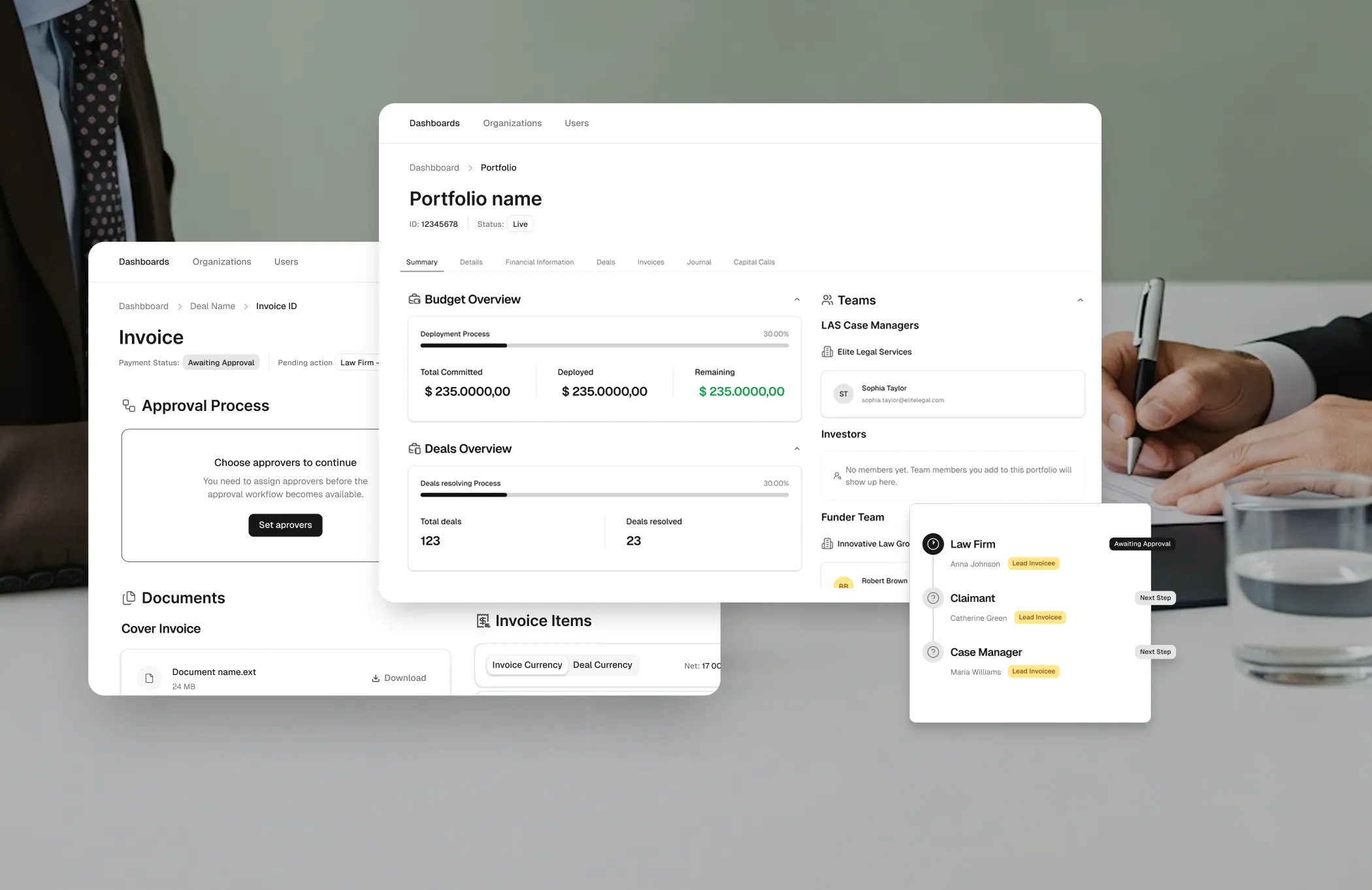
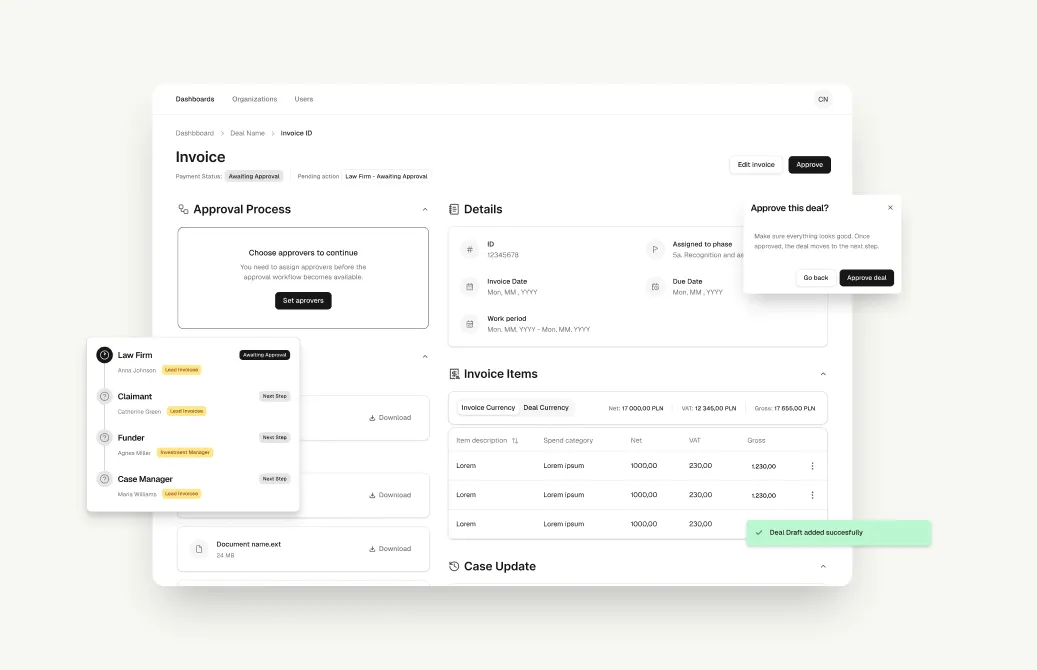
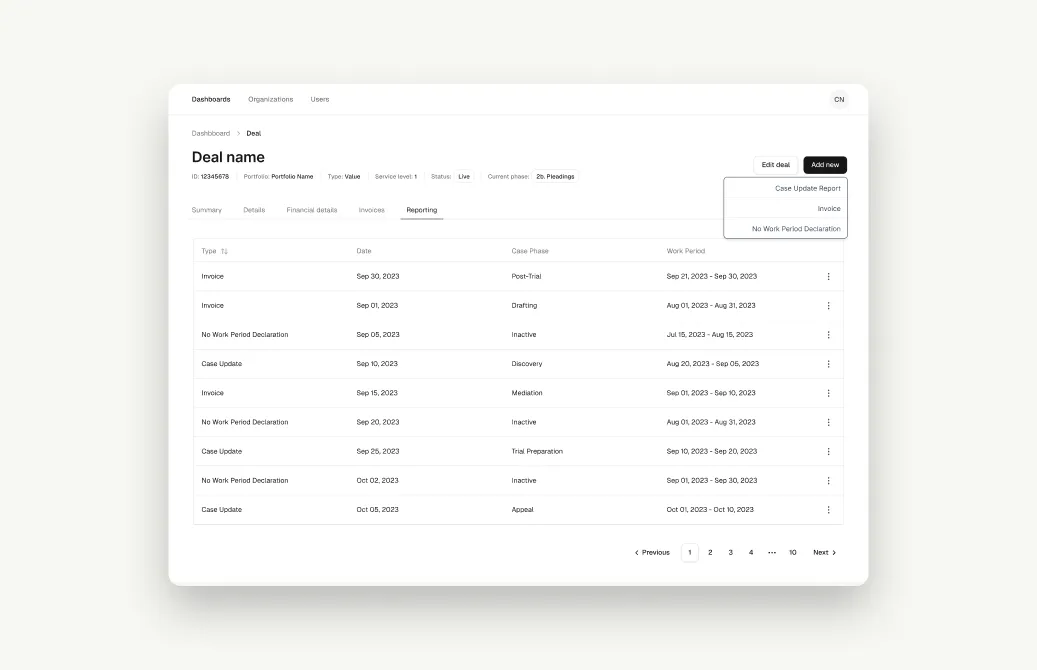
Litigation funding ran on spreadsheets, email chains, and phone calls. With an AI-native delivery process, we turned it into one real-time platform. Now live with funders, law firms, and insurers across the UK, EU, and US.

Product Development Highlights

14 ⟶ 7 d

Backed by Agentic Engineering, feature lead time was cut in half.

–78%

PR cycle time - features ship dramatically faster.

3.4x

More PRs merged per week, powered by AI-first delivery.

Case files
Agreement
Client contract
Appendix
Service agreement
+ 24 more

Spreadsheets couldn’t keep up with scale

Legal Asset Servicing is a Swiss-based platform for legal assets, used by litigation funders, law firms, insurers and their clients.
Before it existed, case tracking ran through Outlook, spreadsheets, and phone calls. Financial data lived in disconnected files across teams, and reporting was slow, often outdated by the time it reached decision-makers. Some firms tried off-the-shelf case management tools, but they were too generic, too expensive, or didn't reflect the unique workflows of legal assets.
The client needed a system built specifically for litigation funding – not a generic case tracker bent into shape. So they brought Vazco in to turn it into a usable and sellable product.
This is some text inside of a div block.

Many workstreams,
one partnership

LAS did not hire four vendors. The same team ran product, AI, delivery process and go-to-market in parallel, which is why the AI work landed where it mattered and the sales material matched what the product actually does.
Product Engineering
Funding workflows turned into a platform that holds up at scale, with cases and portfolios live today in the UK, EU, and US.
Agentic Engineering
AI used to build the product, not just to run inside it. Feature lead time halved, with the process metrics below.
Applied AI
Built into the product rather than bolted on: invoice OCR, document parsing, risk flagging. We ran AI-UX workshops with the client before writing any code, so the effort went to the features where AI changes how the work gets done instead of decorating it.
Go-To-Market
Brand identity, positioning, competitive and market research, and a landing page paired with a live product prototype. Both are in active use with  prospective customers today.
Product Engineering
Funding workflows turned into a platform that holds up at scale, with cases and portfolios live today in the UK, EU, and US.
Agentic Engineering
AI used to build the product, not just to run inside it. Feature lead time halved, with the process metrics below.
Applied AI
Built into the product rather than bolted on: invoice OCR, document parsing, risk flagging. We ran AI-UX workshops with the client before writing any code, so the effort went to the features where AI changes how the work gets done instead of decorating it.
Go-To-Market
Brand identity, positioning, competitive and market research, and a landing page paired with a live product prototype. Both are in active use with  prospective customers today.
Building success together
Hear it from
the LAS Founder
Gian Kull
Legal Funder & Co-Founder, LAS

One platform,
built around the workflow

How we build it

We structured the delivery process to work well with AI-assisted development, then measured it. These numbers cover the development stage itself - pull request to merge.
We're now extending the same measurement to the full lifecycle, from idea to working code, since optimizing one stage in isolation risks just moving the bottleneck upstream instead of removing it. Full feature lead time, from backlog to done, is down from a 14-day baseline to 7 days. Early releases are already coming in below that. The same discipline is now extending upstream, to the stage before development, turning an idea into a ready-to-build task.
Test automation is compounding on itself: the automated suite keeps growing, manual testing keeps shrinking, and full regression is trending toward minutes rather than hours. Some of these tests are now written by AI agents directly, not by hand.

Testing big ideas
in a week

For initiatives that are too big for the next iteration and too uncertain to commit a quarter to, we have a standing format: a five-day AI sprint. Plan in the morning, a working prototype by evening, on the production architecture rather than in a sandbox. By Friday, the question is answered by something you can click through, and the idea either earns a place on the roadmap or gets put down, at the cost of a week instead of a quarter.

It runs alongside normal delivery whenever a question of that size comes up, and it comes from the same principle as everything else here: product work is judged by the impact that ships, not the scope that gets delivered.
"You can't apply AI effectively without understanding the process first. That's what made this project work - we built tech that fits the way legal funding actually operates."
Piotr Pośpiech
Head of Agentic Engineering, Vazco

Building it together

LAS is expanding into new markets, and the team that built the first version is the team building the next one.
We plan together, we ship weekly, and the process we tuned along the way keeps getting faster. It is the kind of partnership where the client's roadmap and ours are the same document.

Still running on manual processes?
Let's make it AI-native.

Michał Zacher, CEO at Vazco
Let’s talk